 Slander Door
Slander Door
Slander Door
Choosing the right door for your space can be daunting. For many homeowners, understanding "how to choose between bi-fold and multi-stacking doors" is crucial. Renowned architect John Harrison states, "The choice between bi-fold and multi-stacking doors often comes down to the desired flow of indoor and outdoor spaces." His expertise provides insight into the decision-making process.
Bi-fold doors typically offer a sleek, modern look and ease of operation. They fold inwards, allowing for expansive openings. Multi-stacking doors, on the other hand, slide and stack to one side. This option can create an even wider entryway. However, some may find them less visually appealing than bi-fold doors. Each option presents benefits and drawbacks to consider carefully.
Take a moment to visualize your space. What kind of natural light do you want? Will guests find the transition seamless? With these considerations, you can navigate the intricacies of your choice. Remember to reflect on both functionality and aesthetics.
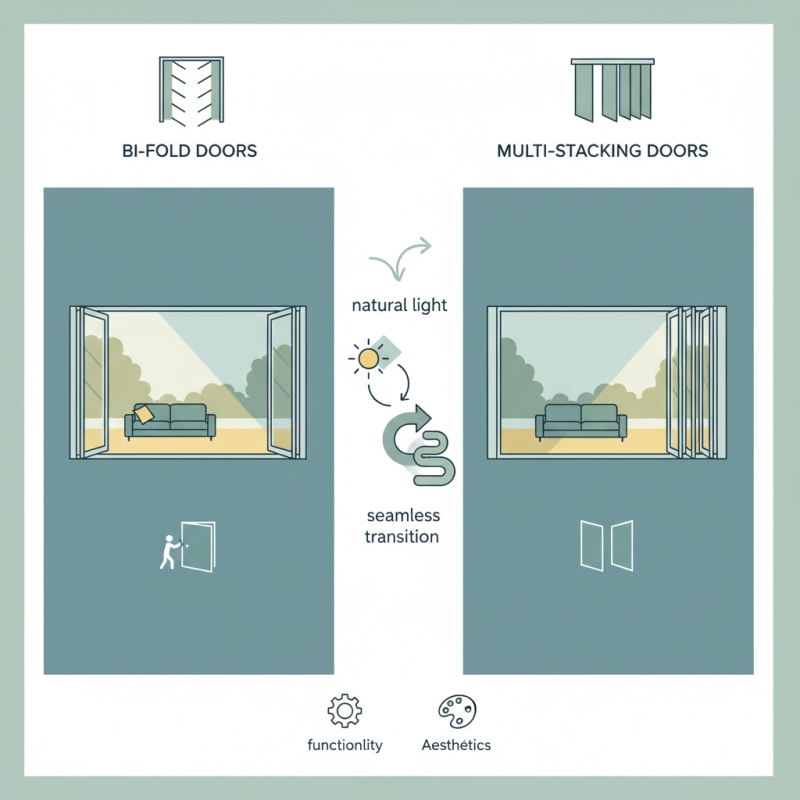
When considering bi-fold and multi-stacking doors, it's important to understand their basic features. Bi-fold doors consist of a series of panels that fold back against a wall. This design allows for a wide opening, perfect for merging indoor and outdoor spaces. On the other hand, multi-stacking doors slide along a track, stacking neatly to one side. This style is great for larger openings and can create a seamless transition.
Both options have their pros and cons. Bi-fold doors often require more space for operation, which may be a challenge in tighter areas. They can also be less effective in high wind conditions. Multi-stacking doors, while versatile, can sometimes feel bulkier when stacked. The choice depends on your specific space and aesthetic preferences. Take time to measure and visualize how each door will fit within your home.
| Aspect | Bi-Fold Doors | Multi-Stacking Doors |
|---|---|---|
| Space Efficiency | Offers a compact stack when opened | May require more space when stacked |
| Accessibility | Easier access to outdoor spaces | May allow for wider openings |
| Design Flexibility | Available in various configurations and materials | High customization for larger openings |
| Insulation | Better thermal insulation options | Varies by system used; typically less insulated |
| Cost | Generally more affordable | Typically higher due to complex mechanisms |
| Installation Complexity | Simpler installation processes | More complicated installation required |
| Maintenance | Requires regular upkeep | More components mean higher maintenance |
| Durability | Strong and long-lasting | Generally durable but depends on the materials |
| Aesthetic Appeal | Offers a contemporary look | Classy and luxurious appearance |
| Functionality | Great for walk-in access and ventilation | Ideal for large openings; excellent for views |
: Bi-fold doors consist of multiple panels folding back against a wall, creating a wide opening.
Multi-stacking doors slide along a track and stack to one side, suitable for larger openings.
They create a seamless indoor-outdoor transition, enhancing your living space.
They require more operational space and may not perform well in high wind conditions.
Bi-fold doors may have gaps impacting insulation, while multi-stacking doors usually offer a tighter seal.
Double or triple glazing can enhance insulation. Consider your natural light needs as well.
Bi-fold doors often need more renovation, increasing costs. Multi-stacking doors can be simpler to install.
Initial costs might be low, but ongoing maintenance expenses can add up.
Yes, unexpected problems can arise, potentially delaying installation and increasing costs.
Reflect on your priorities and evaluate both aesthetics and practicality before deciding.
When considering how to choose between bi-fold and multi-stacking doors, it's essential to understand the fundamental distinctions between these two options. Bi-fold doors typically offer a traditional folding mechanism that provides wide openings, while multi-stacking doors slide and stack discreetly, fitting seamlessly into contemporary designs. Evaluating the space requirements of your area is crucial, as both door types require different clearances and layouts.
Aesthetic preferences play a significant role in this decision-making process, as each door type can complement various architectural styles. Additionally, energy efficiency and insulation capabilities should be assessed to ensure optimal climate control in your space. Finally, analyzing budget implications and installation costs will help you determine the most suitable option for your needs. By carefully weighing these factors, you can make an informed choice between bi-fold and multi-stacking doors that aligns with your vision and requirements.
