Slander Door
Why are louvre doors best for utility room ventilation? In 2026, this question matters more as homes become tighter, quieter, and more energy efficient. Utility rooms contain washing machines, tumble dryers, boilers, water heaters, and cleaning products. These appliances can produce heat, moisture, and stale air within a small space.
Louvre doors support passive air movement through angled slats. Air can enter and escape without leaving the door fully open. This helps reduce condensation around pipes, walls, and appliance cabinets. Building scientist Dr. Joe Lstiburek states, “If you don’t control air, you don’t control moisture.” His observation explains the practical value of controlled airflow in compact service areas.
A well-fitted louvre door can create a visible difference. Warm air rises through the upper openings, while cooler replacement air enters below. The room may feel less stuffy after a drying cycle. Still, louvres are not a complete ventilation system. They cannot replace mechanical extraction where regulations, appliance instructions, or moisture levels demand it.
Door sizing also requires care. Slats that are too narrow may restrict airflow. A blocked threshold can reduce the lower air path. Dust can collect on the slats, especially beside dryers. Regular cleaning remains necessary.
My practical view is slightly cautious. Louvre doors are effective, affordable, and simple, but only when the whole airflow route works. The best design considers door area, adjacent-room ventilation, appliance clearance, noise, privacy, and fire safety. This balanced approach makes the answer clearer than choosing louvres by appearance alone.
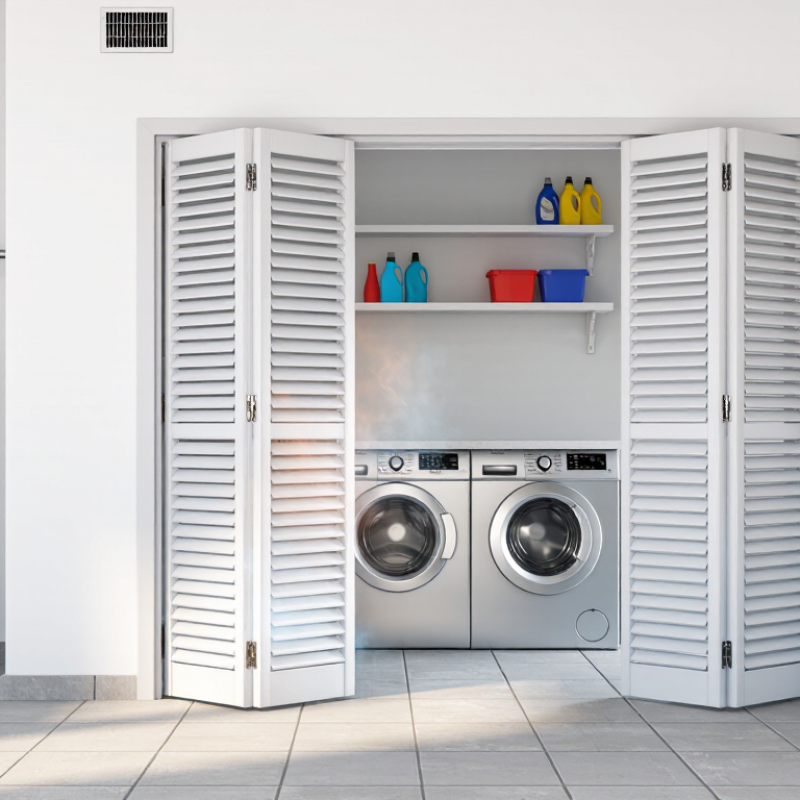
Louvre doors are interior doors fitted with angled slats or openings. These gaps allow air to move between a utility room and nearby spaces. A solid door can trap warm, damp air inside. Air needs a path.
In a utility room, a washing machine, dryer, sink, and hot-water equipment may raise humidity quickly. Louvre doors help replace stale air with drier air from the hallway. They also support an extractor fan by providing make-up air. Without that airflow, a fan may work harder and remove moisture less effectively. During home maintenance work, I have noticed less condensation when the door opening remains clear. That matters near cold pipes and painted walls.
The door does not create ventilation alone. It should work with suitable mechanical extraction, wall vents, or windows where appropriate. Slat spacing, door size, and the room’s equipment all affect performance. A narrow door with small openings may provide less airflow than expected. That is an easy detail to overlook. The openings can also reduce privacy and allow some machine noise to escape. Louvre doors are not perfect.
For reliable results, keep baskets, boxes, and cleaning supplies away from the lower slats. Check that the door swings freely and that vents are not blocked by dust. A qualified installer can assess airflow needs, moisture levels, and applicable building requirements before fitting the door. In some rooms, a fire-rated or sealed door may be necessary, so ventilation choices should never ignore the building’s specific safety design.
Louvre doors support utility room ventilation by allowing air to pass through angled slats. This matters when a washer, dryer, sink, or water heater warms a small enclosed space. In practice, blocked doors often leave laundry rooms smelling stale. Moisture also lingers around damp fabrics and cold pipework.
The U.S. Environmental Protection Agency recommends indoor relative humidity between 30% and 50%. Above that range, condensation and mold risk can increase. Louvre slats create a continuous transfer path, helping replacement air enter when an exhaust fan operates. ASHRAE Standard 62.2-2022 also emphasizes adequate ventilation for acceptable indoor air quality. The door does not provide mechanical extraction. It only helps air move toward the intended exhaust route.
Slat spacing and open area deserve careful attention. A solid door can restrict airflow, especially when the room has no undercut. A well-designed louvre may reduce pressure resistance, but actual performance depends on fan capacity, duct length, and grille placement. Small details matter. Keep slats clear of lint and dust. Maintain the dryer exhaust separately, because shared or obstructed paths can create problems. A 2023 building-science review found that moisture control works best through combined source control, ventilation, and surface-temperature management. That is a useful warning: louvre doors help, but they cannot fix a weak fan or a leaking appliance. My own assessment is less absolute than many product claims. Better airflow is likely, yet measured results should guide the final design.
Utility rooms need airflow, but not every louvre door performs equally. EPA reports that indoor pollutant levels can be two to five times higher than outdoor levels. Moisture, detergent vapour, and heat can concentrate behind a closed door. A properly sized louvre helps transfer air toward an exhaust fan or return grille. It should not replace mechanical ventilation.
Material choice depends on humidity and cleaning habits. Powder-coated steel suits laundry rooms with frequent impacts and damp floors. Aluminum resists corrosion and remains relatively lightweight. PVC or composite doors work well near washing machines because they tolerate splashes and do not absorb water. MDF can look attractive, but unsealed edges may swell. That mistake is common.
Fixed louvres offer reliable airflow with fewer moving parts. Adjustable blades provide flexibility, although dust can collect around their pivots. Ask suppliers for tested free-area data, using methods such as AMCA 500-L. A larger visible opening does not always mean better airflow. The U.S. Department of Energy recommends controlling moisture and maintaining effective exhaust pathways in residential utility spaces. ASHRAE Standard 62.2 also emphasizes whole-building ventilation and pollutant control. In practice, I would check fan capacity, door clearance, and airflow direction together. A louvre door can be excellent. It can also expose stored chemicals to warm air, so placement still needs careful review.
| Material or Design | Ventilation Performance | Moisture and Heat Resistance | Durability and Maintenance | Sound and Privacy | Best Utility Room Application | Key Selection Notes |
|---|---|---|---|---|---|---|
| Painted solid wood louvre door | Fixed slats allow continuous passive air movement when the door is closed. The airflow depends on slat angle, spacing, door size, and the free area of the louvre opening. | Suitable for normally dry utility rooms. Wood can swell, warp, or split when repeatedly exposed to condensation or standing water. | Good service life when properly sealed on all faces and edges. Inspect the finish regularly and repaint damaged areas. | Provides limited privacy and moderate sound reduction. Wider slat gaps increase airflow but reduce privacy and acoustic separation. | Interior laundry rooms with controlled humidity and no direct water spray. | Use moisture-resistant paint or coating, keep the bottom edge above wet floors, and avoid blocking the louvre openings with storage. |
| Moisture-resistant engineered wood | Provides reliable passive ventilation through fixed or adjustable slats. Stable core materials generally keep their shape better than ordinary solid timber in changing indoor humidity. | Better dimensional stability than standard wood, but it is not waterproof. Unsealed cut edges remain vulnerable to moisture. | Smooth coated surfaces are easy to wipe. Edge sealing is important around hinges, handles, and the lower rail. | Offers a balanced combination of airflow, visual privacy, and moderate noise control. | Most residential utility rooms, especially rooms containing a washing machine or tumble dryer. | Choose a product specifically rated for interior humid areas and maintain clearance around the door for unrestricted airflow. |
| Aluminium louvre door | Fixed or adjustable aluminium slats provide consistent ventilation and are suitable where a high free-air area is required. | Naturally resistant to rust in normal indoor conditions. It tolerates humidity and temperature changes better than untreated wood. | Low maintenance; clean with a mild detergent and check fixings periodically. It can dent if struck heavily. | Usually provides less sound reduction than a solid-core door. Adjustable slats can improve privacy when partly closed. | Humid utility rooms, equipment cupboards, and spaces requiring durable, low-maintenance ventilation. | Use a corrosion-resistant finish in damp locations and avoid abrasive cleaners that may damage the coating. |
| Powder-coated steel louvre door | Delivers dependable airflow through fixed vents and can be specified with a relatively large ventilated area. | Strong resistance to heat and everyday moisture when the coating is intact. Scratches or exposed edges can allow corrosion to begin. | Very robust and suitable for frequent use. Touch up chips promptly and keep louvre channels free of lint. | Provides limited acoustic privacy because the ventilated sections remain open to sound transmission. | Shared utility areas, service cupboards, and high-traffic residential or light-commercial interiors. | Select a factory-finished, corrosion-protected product and verify that the door weight is compatible with the frame and hinges. |
| PVC or composite louvre door | Offers continuous passive airflow through moulded or assembled slats. Performance varies considerably by the actual open area of the design. | Good resistance to household humidity and occasional splashes. Some products may soften or deform near significant heat sources. | Easy to clean and does not require repainting. Inspect slats for cracks and avoid harsh solvents. | Generally provides limited sound insulation and moderate visual screening. | Compact utility rooms where easy cleaning and moisture resistance are more important than premium appearance. | Keep the door away from heaters and hot appliance exhausts unless the product is specifically designed for elevated temperatures. |
| Full-height fixed louvres | Maximize passive ventilation over most of the door height and reduce the chance that airflow will be obstructed by furniture or appliances. | Material performance depends on the substrate and finish. The large ventilated area can also allow humid air to move freely between spaces. | Simple construction usually means fewer moving parts and straightforward cleaning. | Lowest privacy and acoustic performance among common louvre configurations. | Utility rooms where ventilation is the primary requirement and visual or acoustic separation is secondary. | Confirm that the room has an appropriate moisture-extraction strategy; a louvre door transfers air but does not remove moisture by itself. |
| Half-louvre, half-solid door | Provides useful air transfer while retaining more solid surface area than a full-louvre door. The available ventilation area is lower than a full-height design. | The solid section can be selected for humidity resistance, while the louvre section needs protection from lint and dust. | Easier to repair or refinish than a fully ventilated door if the solid panel is damaged. | Better visual privacy and somewhat better sound control than full-height louvres. | Utility rooms adjoining hallways, kitchens, or living areas where appearance and privacy matter. | Use when the room has additional ventilation, such as an exhaust fan or a suitable wall vent, and the door is mainly for air transfer. |
| Adjustable louvre design | Slat angles can be changed to balance air movement, privacy, and light. Fully open slats provide the greatest airflow. | Select moisture-resistant hardware and a suitable finish; moving parts may require more care in humid conditions. | More components mean more inspection points. Clean slat pivots and check that controls remain secure. | Better privacy control than fixed louvres, although closed slats may significantly reduce airflow. | Utility rooms that need flexible control between drying cycles, storage periods, and everyday use. | Do not keep the slats fully closed when the room is producing heat or moisture unless another ventilation route is operating. |
| Louvre door with insect screen or filter panel | Allows air transfer while helping reduce insects or airborne lint entering through the opening. Added screens create resistance and reduce the effective free area. | Choose a washable, moisture-tolerant screen and allow it to dry fully after cleaning. | Requires regular vacuuming or washing because lint and dust can restrict airflow. | Offers little improvement in sound insulation, but can improve cleanliness and comfort. | Utility rooms connected to garages, external corridors, or areas where insects and dust are a concern. | Check the screen frequently; a blocked filter can make a well-designed louvre door ineffective. |
| Door with transfer grille | A grille positioned in the door can provide a defined air-transfer route. The grille size and free area should be selected for the room's ventilation design. | Metal, coated plastic, or composite grilles can perform well in humid interiors when correctly installed and sealed. | Usually easy to remove and clean. Fasteners and edges should be checked for looseness or corrosion. | Can provide better visual control than open louvres when fitted with an angled or screened grille, but it still transmits some sound. | Utility rooms where a standard door is preferred but controlled air transfer is required. | The grille must not be covered by baskets, cabinets, rugs, or appliance hoses, and it should complement rather than replace required mechanical extraction. |
Louvre doors can improve utility room airflow by allowing air to pass through angled slats. They are useful where a solid door would trap heat, moisture, or appliance exhaust.
Before ordering, measure the existing frame in three places: top, middle, and bottom. Record the smallest width. Measure height from the finished floor to the underside of the frame. Do not assume the opening is perfectly square.
Choose a door that fits the smallest measurement, allowing the manufacturer’s recommended fitting clearance. Check the slat area, not only the overall door size. A narrow door with small openings may provide less airflow than expected.
Confirm that the room still has a suitable air path, especially when a dryer, boiler, or extractor fan operates. Local building requirements may specify ventilation areas, so verify them with a qualified installer.
Tips:
Remove trim carefully and protect the floor before installation. Mark hinge positions at a comfortable height, then pre-drill to prevent splitting. Hang the door loosely first, and test its swing before tightening every screw. Keep the slats unobstructed by shelving or stored laundry. A small bottom gap may help airflow, but it should not replace required ventilation openings. I have found that uneven floors can make a correctly measured door rub slightly. A thin threshold adjustment may solve it, though rushing this step often creates louder movement and poor alignment.
Louvre doors help utility rooms exchange air through angled slats, especially when appliances create heat or moisture. Their performance depends less on appearance than on clear openings and balanced airflow. Inspect the slats monthly. Dust, lint, and detergent residue can narrow each passage. Use a vacuum brush, then wipe with a barely damp cloth. Do not soak unfinished wood. Moisture can swell it.
Check hinges, handles, and the door gap during each cleaning. A dragging door may signal loose screws, floor movement, or a swollen frame. Tighten hardware carefully, but avoid over-tightening. The door should close without scraping. Keep storage boxes away from the lower grille and nearby wall vents. Blocked air paths can leave damp smells, condensation, or warm pockets around equipment. Poor airflow is often mistaken for a faulty fan.
If the room has an exhaust fan, clean its cover and confirm that air moves toward the outlet. A tissue test can reveal weak movement, though it is not a full safety inspection. Never paint over the louver openings. That shortcut looks neat, but it can reduce ventilation. Replace cracked slats or badly warped panels rather than forcing them straight. Check them often. A recurring maintenance lesson is that rushed work causes the biggest problems. Record dates, moisture observations, and repairs in a simple log. If condensation persists, consult a qualified ventilation professional.
Louvre doors allow transfer air to reach an extract fan while maintaining privacy. They should be used with a properly sized ventilation system and should never be blocked by lint, dust, paint or stored items.
The chart shows commonly specified utility-room extract airflow benchmarks from England’s Approved Document F: 8 L/s for continuous extract and 30 L/s for intermittent extract. These values equal approximately 28.8 m³/h and 108 m³/h. Clean the louvre openings regularly, keep the airflow path unobstructed, and verify fan performance if condensation, odours or mould appear.
Reference: Approved Document F, Volume 1, Table 1.3, England. Louvre doors provide air transfer; they do not replace mechanical extract or outdoor air provision.
Powder-coated steel handles impacts and damp floors well. Aluminum resists corrosion and stays lightweight. PVC or composite tolerates splashes. Unsealed wood-based panels may swell. That mistake is easy to miss.
Fixed louvres offer steady airflow with fewer moving parts. Adjustable blades allow control but can collect dust around their pivots. Neither option replaces mechanical ventilation.
Measure the width at the top, middle, and bottom. Use the smallest measurement. Measure height from the finished floor to the frame underside. Do not assume the opening is square.
No. Slat size and free opening area matter more than appearance. A wide door with narrow openings may move less air. Ask for tested airflow data.
Confirm fitting clearance and airflow direction. Check the fan, appliance exhaust, and door swing together. Local requirements may specify minimum ventilation openings. A qualified installer can verify them.
Test the swing before fully tightening the screws. Uneven floors can cause rubbing. A thin threshold adjustment may help. Rushing this step often creates noise.
Inspect them monthly. Remove lint and detergent residue with a vacuum brush. Wipe with a barely damp cloth. Do not soak unfinished wood. Keep the passages clear.
Condensation, damp smells, and warm pockets are warning signs. A tissue can show weak air movement. It is not a complete safety inspection. Persistent moisture needs professional review.
Avoid it. Paint can narrow the passages and reduce airflow. Replace cracked or badly warped slats instead of forcing them straight. A neat shortcut can create a larger problem.
Why are louvre doors best for utility room ventilation? Their angled slats allow air to move continuously between the utility room and adjacent spaces while maintaining privacy and reducing the need to keep the door open. This steady airflow helps disperse heat, odors, and humidity from appliances such as washing machines and dryers, limiting moisture buildup that can contribute to stale air, condensation, and surface damage.
Louvre doors can be made from moisture-resistant wood, composite materials, or durable metal, with designs selected to match the room’s size and style. Correct measurement is essential: the door, frame, and ventilation gaps must fit securely without blocking the slats. Installation should also allow sufficient clearance for smooth operation and effective air circulation. Regular cleaning keeps dust from clogging the slats, while checking hinges, fasteners, and surface finishes helps prevent common problems such as rattling, sticking, reduced airflow, and moisture-related deterioration.
